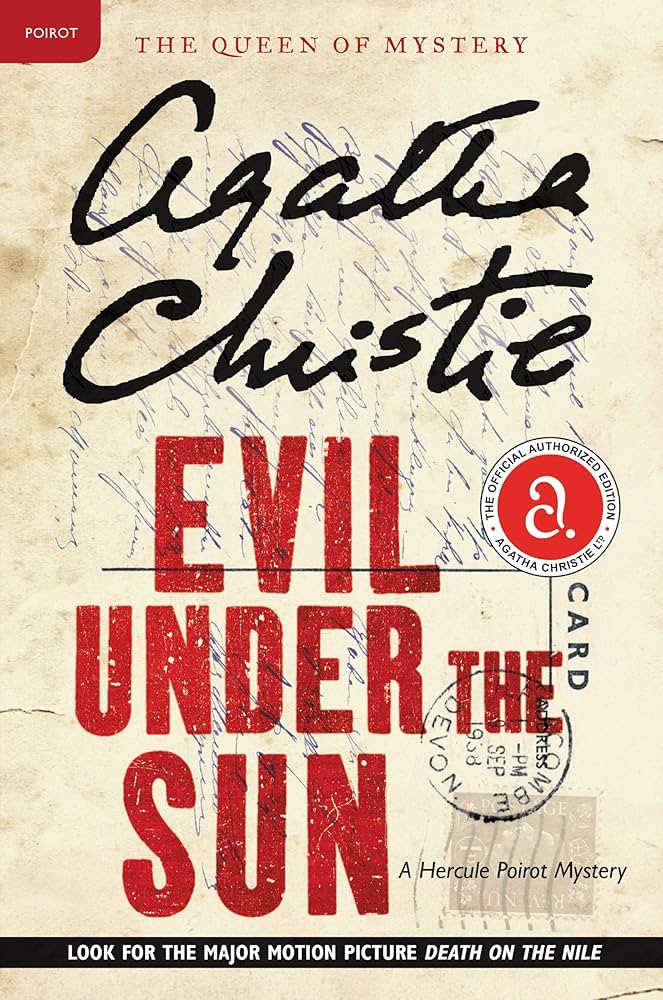
Evil Under the Sun
| Published | 1941-06-01 |
| Series | Hercule Poirot Mysteries (Book 22 of 45) |
| Genre | Cozy Mystery, Crime Fiction |
| Language | English |
| Publisher | Collins Crime Club (UK) |
| ISBN-10 | 0062073931 |
| ISBN-13 | 978-0062073938 |
📝Honest Review
The setting deserves a great deal of credit for what the book achieves. Smugglers' Island and the Jolly Roger Hotel are Christie at her best as a scene-builder. The island is deliberately sealed off from the mainland, reachable only by boat, which creates a natural pressure cooker for the people confined to it. The sun, the beaches, the summer holiday atmosphere give the whole book a surface warmth that sits in deeply uncomfortable contrast with the jealousy and calculation and barely suppressed hostility running underneath every conversation at the dinner table. Christie has always been good at using pleasant settings to make unpleasant truths feel more disturbing, and here she is working at full power.
Arlena Marshall, the victim, is one of Christie's most carefully constructed murder victims. She is not especially sympathetic. She is vain, careless about the feelings of others, openly predatory in her behavior with married men, and almost entirely indifferent to the damage she leaves in her wake. Christie gives you multiple reasons to dislike her, which is exactly the point, because a woman everyone dislikes is a woman everyone had reason to want dead, which means that when the murder happens the pool of suspects is the entire hotel. Christie uses Arlena's unpopularity as a structural tool, and she does it without making the victim a mere object. There is a sense throughout the book that Arlena is being exploited in ways she does not quite understand, and that awareness, which only becomes fully clear at the end, gives her a retrospective pathos that shifts the moral weight of the whole novel.
The other guests are drawn with Christie's characteristic efficiency. Patrick Redfern, the man having the affair, is charming and convincing in a way that immediately makes you slightly uneasy, which is also exactly the point. Christine Redfern, his wife, is the sort of quietly suffering woman Christie was very good at rendering without sentimentality. Kenneth Marshall, Arlena's husband, is steady and decent and therefore almost entirely opaque, which is a technique Christie uses more often and more deliberately than she is usually given credit for. The other guests orbit the central drama with varying degrees of involvement, and Christie uses the social dynamics of the holiday hotel with real wit.
The central trick of the novel is one of Christie's most purely mechanical, which is both its greatest strength and its one real limitation. When the solution is revealed, the cleverness of the construction is immediately apparent. It is a puzzle of timing, of how time of death was manipulated, and Christie lays the clues for it with immaculate precision. Every piece of information you need is present. The problem is that the solution depends on a level of premeditation and physical coordination that strains credibility slightly, a point even the New York Times review at the time noted. Christie was aware of this kind of criticism and never found it entirely fair, and she was not entirely wrong. The ingenuity of the mechanism is its own justification. But readers who think carefully about the logistics may find themselves asking whether certain things could truly have been executed as smoothly as the book requires.
What lifts Evil Under the Sun above a mere mechanical exercise is Poirot himself. He is in excellent form here, sitting in his deck chair and watching, making observations that seem idle and are not, asking questions that seem irrelevant and absolutely are not. There is a scene early in the book where he talks to a fellow guest about evil, about whether it is a force that exists in places or in people, that is more philosophically interesting than it needs to be and which Christie plants as both a theme and a clue. She does that kind of double-duty writing better than anyone.
The ending has that quality which is the hallmark of Christie's best work. When Poirot assembles the suspects and begins to explain, you find yourself mentally running back through the book and locating, one by one, all the things you either missed or misread. The experience is not of being cheated. It is of being outplayed, which is entirely different, and considerably more satisfying.
Summary:
Hercule Poirot arrives at the Jolly Roger Hotel on Smugglers' Island, a secluded rocky resort off the Devon coast, hoping for nothing more than sunshine, sea air, and freedom from murder. He does not get it. Among the guests is Arlena Marshall, a former actress whose beauty is as conspicuous as her behavior is reckless. She is openly conducting a flirtation with Patrick Redfern despite both of them being married to other people, and the other guests watch with a mixture of fascination, disapproval, and thinly veiled resentment. Then one morning Arlena is found strangled on the beach at Pixy Cove, lying face down in the sun. The obvious answer is a crime of passion. Patrick Redfern is seen by several witnesses at the hotel at the time of the murder. So is almost everyone else with a motive. Poirot begins to suspect that the obvious answer is exactly what someone very clever wants him to believe.
✅ What I Liked
The timing mechanism at the heart of the murder is one of Christie's most satisfying constructions, fair and surprising in equal measure. The holiday hotel setting is used with real intelligence, every detail of the geography and the social dynamics contributing to the puzzle. Arlena Marshall is a far more carefully drawn victim than she first appears. Poirot's early philosophical conversation about the nature of evil pays off in a way that only becomes clear in retrospect. And the final reveal is delivered with the kind of unhurried confidence that only comes from a writer completely in control of her material.
❌ What Could Be Better
The solution requires a degree of coordination and precise timing between the killers that is logistically ambitious to the point of mild implausibility. A handful of the supporting hotel guests are thin enough that they feel like placeholder suspects rather than fully realized people. And readers who have encountered Christie's similar short story Triangle at Rhodes before reading this novel may find certain elements of the setup familiar enough to give the game away earlier than Christie intends.
Discover Your Next Great Read
Handpicked recommendations from our collection of literary treasures

💬Discussions