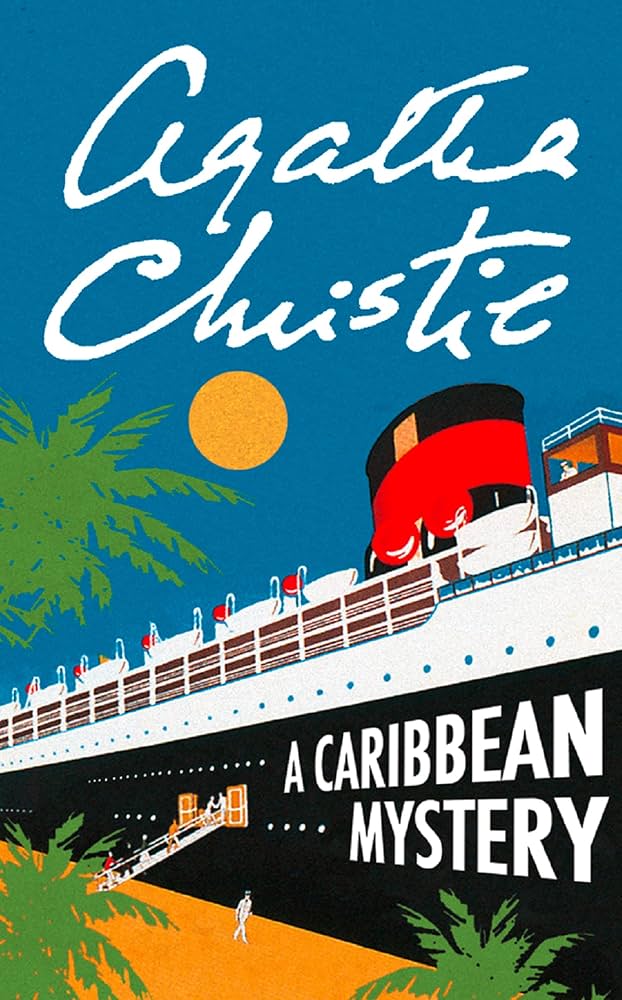
A Caribbean Mystery
| Published | 1964-11-16 |
| Series | Miss Marple Mysteries (Book 10 of 12) |
| Genre | Cozy Mystery, Crime Fiction |
| Language | English |
| Publisher | Collins Crime Club (UK) |
| ISBN-10 | 0553350323 |
| ISBN-13 | 978-0553350326 |
📝Honest Review
Miss Marple as a character has always been underestimated , by the people around her and, honestly, by some readers too. She's old, she's frail, she rambles about her garden and her village gossip, and people smile politely while tuning her out. That's exactly why she's so dangerous. In A Caribbean Mystery, Christie leans into this beautifully. Miss Marple is surrounded by a world of sun, cocktails, and holiday cheer , and she's the only one paying attention. While everyone else is relaxing, she's watching. Noticing the small things. The hesitation. The look that crosses someone's face for just a second before they compose themselves.
The Caribbean setting itself is a character here. Christie wrote this book inspired by her own trip to the West Indies, and you can feel that firsthand warmth in how she describes the sea, the heat, the unhurried rhythm of resort life. It's lush and peaceful and deliberately seductive , which makes the deaths feel all the more jarring when they come. Christie uses the paradise backdrop as a kind of irony: beautiful surroundings, ugly human nature. It works extremely well.
The supporting cast is excellent. Mr. Rafiel , the blunt, wheelchair-bound millionaire who becomes Miss Marple's unlikely ally , is one of Christie's most memorable side characters. Their dynamic is genuinely fun to read. He doesn't coddle her or dismiss her, he just deals with her directly, which she seems to find refreshing. Together they make an odd but effective team, and their scenes together have a dry, witty energy that keeps things moving even when the plot slows down slightly in the middle.
The mystery itself is tightly constructed in the way only Christie could manage. Clues are planted so naturally into casual conversation and everyday observation that you read right past them. And then when everything snaps into place at the end, you go back in your head and think , it was all there. Of course it was. It's always all there with Christie. You just never see it in time.
This is not Christie's most ambitious book. It is compact, straightforward, and does exactly what it sets out to do without overreaching. But that's also precisely why it's so satisfying. Sometimes a perfectly constructed mystery set in a beautiful location with a brilliant detective is all you need, and A Caribbean Mystery gives you that in 180 pages without a single wasted chapter.
Summary:
Miss Marple's nephew Raymond sends his elderly aunt on a well-deserved holiday to the Golden Palm resort on the sunny Caribbean island of St. Honoré, hoping she'll finally get some rest. But Miss Marple being Miss Marple, rest is the last thing she gets. When a retired military man named Major Palgrave is about to show her a photograph of an alleged murderer, he suddenly stops, his eyes fixed on something behind her shoulder, and abruptly changes the subject. By the next morning he is dead , officially of natural causes. Miss Marple is not convinced. What follows is a web of secrets, suspicious deaths, and a cast of resort guests who are all hiding something, as the sharp-eyed old lady from St. Mary Mead quietly unravels what the police cannot.
✅ What I Liked
The central mystery is engineered with Christie's usual surgical precision , clues are in plain sight and you still miss them. Miss Marple's dynamic with Mr. Rafiel is warm, witty, and one of the highlights of the whole Marple series. The Caribbean setting is vivid and atmospheric without ever becoming a postcard cliché. The book is short enough that it never outstays its welcome, which is a discipline a lot of modern mystery writers could learn from. And Christie's quiet feminist point , that the most observant person in the room is the old woman everyone ignores , never gets old.
❌ What Could Be Better
The middle section sags a little, and a few of the resort guests blur together as characters. Some of the deaths that pile up feel slightly convenient rather than earned. And if you've read a lot of Christie, you may spot one of the key misdirections earlier than she intends, simply because you've seen the pattern before. It's a minor gripe , this is Christie at a comfortable cruise altitude, not quite at her ceiling, but nowhere near coasting either.
Discover Your Next Great Read
Handpicked recommendations from our collection of literary treasures






💬Discussions