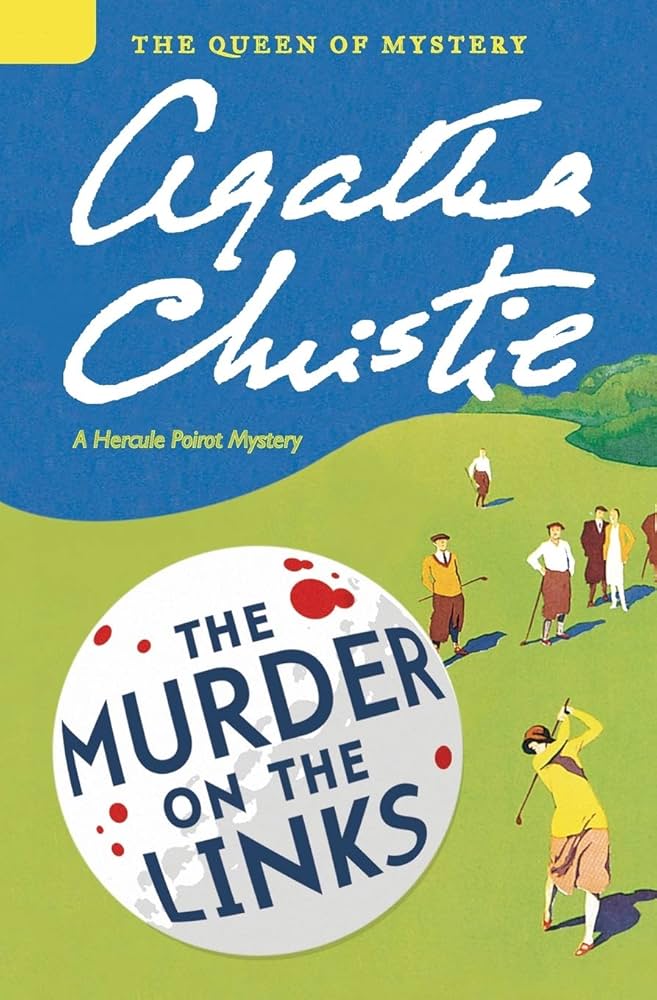
The Murder on the Links
| Published | 1923-05-01 |
| Series | Hercule Poirot Mysteries (Book 2 of 45) |
| Genre | Cozy Mystery, Detective Fiction |
| Language | English |
| Publisher | The Bodley Head (UK) |
| ISBN-10 | 0007119283 |
| ISBN-13 | 978-0007119288 |
📝Honest Review
The French influence on this novel is real and significant. Christie freely acknowledged that she had written it in a high-flown, fanciful manner, drawing on the style of Gaston Leroux and the theatrical traditions of French crime fiction rather than the restrained English country house atmosphere of Styles. The result is a book with a different energy, more melodramatic, more emotionally heated, with a romantic subplot that takes up considerably more space than Christie would typically allow in her mature work. This is not necessarily a criticism. The melodrama is part of the book's particular flavor, and there are stretches where it genuinely works, where the heightened emotional atmosphere makes the central mystery feel more urgent rather than less.
Hastings in love is both the novel's most distinctive feature and its most uneven one. His obsession with Cinderella, the nickname he gives to the young woman with the knife, has a breathless, slightly absurd quality that Christie plays partly for gentle comedy and partly for genuine romantic feeling. She later wrote that she was quite deliberately disposing of Hastings in this novel, giving him a wife and shipping him off to Argentina so that she could write Poirot without the constraint of the narrator-companion relationship. Knowing that intention makes the Hastings subplot read differently, as a fond farewell to a dynamic she had established but was already finding limiting.
The central mystery is built around a device that Christie would refine to far greater effect in later novels, the idea that a crime draws its structure from an earlier, similar crime, that a killer may be unconsciously repeating a pattern. Poirot's insight that human nature does not change, that even a murderer's method carries signatures that persist across time, is one of his most interesting recurring ideas, and here it is stated explicitly and used as the foundation of the solution. The execution is somewhat mechanical compared to the seamless integration Christie would achieve later, but the idea itself is excellent, and you can see her feeling her way toward something that would serve her well for decades.
The rival detective Giraud, the man from the Paris Sûreté who dismisses Poirot as an old fool and races around collecting physical evidence while Poirot sits and thinks, is a deliberate structural foil. He represents the physical, empirical approach to detection against Poirot's psychological method, and Christie uses the contrast to argue, not very subtly, for the superiority of the interior approach over the exterior one. The argument is slightly schematic, but the character of Giraud is drawn with enough energy that he functions well as an antagonist, and the final scene in which Poirot reveals his solution in front of Giraud has a genuine satisfaction to it.
The solution itself is well-constructed, drawing on a small but important physical detail that Christie plants early and trusts the reader to notice and correctly interpret. Most readers will not interpret it correctly, which is entirely by design. The revelation that the detail actually implies is clever, though it depends on a coincidence of identity that Christie would probably have handled more carefully in her later, more precise work. The double murder, which seems impossibly complex in the middle section of the novel, turns out to have a coherent explanation that accounts for both deaths without requiring the suspension of disbelief that some of Christie's more mechanical puzzles demand.
This is an enjoyable, energetic, and genuinely interesting book that earns its place in the Poirot canon even if it sits below the author's greatest achievements. It is Christie finding her voice, and the voice she is finding is already a remarkable one.
Summary:
Hercule Poirot receives an urgent letter from Paul Renauld, a wealthy Canadian businessman living in the north of France, begging for his immediate assistance. Renauld writes that his life is in danger, that he has discovered a plot against him, and that he cannot yet explain the details but needs Poirot there at once. Poirot and Hastings travel to Merlinville-sur-Mer immediately. They arrive too late. Renauld is already dead, stabbed in the back and buried face down in a freshly dug grave on the golf course adjoining his villa. Before Poirot can begin his investigation properly, the case is turned violently upside down by the discovery of a second corpse, identically murdered. A hostile detective from the Paris Sûreté has already formed his own theory and is not interested in Poirot's interference. Meanwhile, Hastings has fallen helplessly in love with a girl he met on the train, a young woman with a knife at her belt and a talent for appearing exactly when she should not.
✅ What I Liked
The French setting gives the novel a distinctly different atmosphere from most of the Poirot canon, more heated and theatrical in ways that suit the melodramatic plot well. The central idea, that a murderer's method carries persistent signatures across time, is one of the most interesting conceptual moves in Christie's early work. Giraud as a rival is a satisfying antagonist, and his defeat is proportionately satisfying. And Hastings falling in love has a genuine sweetness to it, even if the subplot occupies more space than it perhaps deserves.
❌ What Could Be Better
The novel is more melodramatic and less precisely controlled than Christie's mature work, and the coincidences that hold the central plot together are more visible here than in her best books. The romantic subplot, while charming, does interrupt the mystery's momentum at several points. And the solution, while fair, depends on a coincidence of identity that Christie would have found a more elegant way to motivate in later years.
Discover Your Next Great Read
Handpicked recommendations from our collection of literary treasures

💬Discussions